
Knowledge · Lipedema diagnosis Recognising lipedema: two typical fat pads.
Two localised fat pads – over the coccyx and on the inner side of the upper lower leg – can be a clear indication of lipedema. This is described in a paper by Dr. med. Sebastian Michel and colleagues, published in 2021 in the German journal LymphForsch. In pure obesity, the fat layer is not thickened in these areas.
Slim women in particular often go without a correct diagnosis for a long time in the early stages. The two areas can help to recognise lipedema sooner.
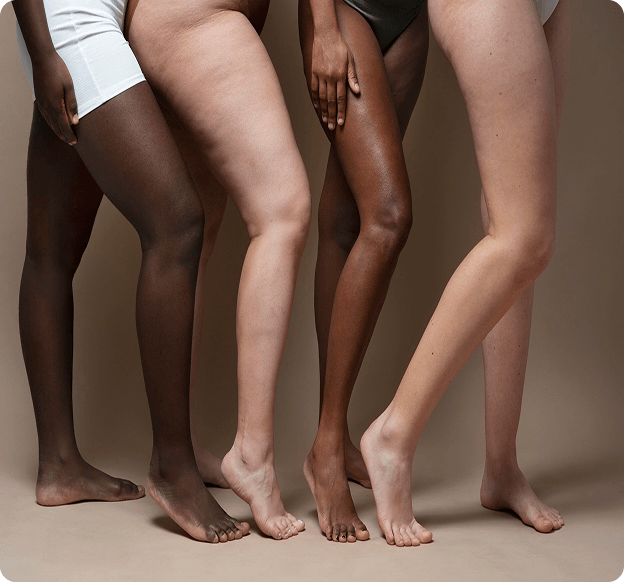
- Area 1
- Over the coccyx, about 8 × 8 cm
- Area 2
- Inner upper lower leg, about 9 × 9 cm
- Detection
- Medical examination, also by ultrasound
- Significance
- Clear indication, not proof on its own
Why is lipedema so often overlooked?
Lipedema cannot be confirmed with a single test. The diagnosis is based on the medical history and a physical examination. Because the fat accumulation is easily mistaken for obesity, many women go without a correct diagnosis for a long time.
The paper assumes that around 10% of women have lipedema; according to the German S2k guideline, reliable figures on its frequency are lacking so far. In the past, affected women were often considered overweight and advised to lose weight. Lipedema fat, however, barely responds to diet and exercise.
According to the authors, slim women in the early stages in particular are often overlooked or diagnosed only after a considerable delay. Additional, easily recognisable signs are especially valuable for them.
Which two fat pads are typical of lipedema?
In patients with a confirmed lipedema diagnosis, Dr. Michel and colleagues found two recurring fat pads: one over the coccyx and one on the front inner side of the upper lower leg, just below the knee. The authors also call them “hotspots”.
Over the coccyx
A fat pad of about 8 × 8 cm directly over the tailbone. The fat layer is normally thin here, so any thickening is noticeable during examination.
On the inner upper lower leg
A fat pad of about 9 × 9 cm on the inner side of the lower leg below the knee. Patients often find this area particularly bothersome and frequently report typical symptoms there.
Both pads can be felt during a physical examination and are clearly visible on ultrasound. Lipedema patients of normal weight often show this distribution pattern too.
How does this differ from obesity?
In pure obesity, the two fat pads are absent: the fat layer is not thickened over the coccyx or on the upper lower leg. This makes the two areas a helpful way to tell lipedema and obesity apart.
The distribution of fat also differs: in lipedema, it accumulates on the arms and legs; the hands and feet are spared. The German S2k guideline considers the trunk, head and neck unaffected; in our clinical experience, however, lipedema can also affect the abdomen, back, neck and face. In obesity without lipedema, by contrast, fat is distributed evenly and also affects the trunk. Lipedema and obesity can, however, occur together.
What other signs point to lipedema?
The fat pads are one part of the diagnosis, not the only one. Doctors consider them together with symptoms and medical history.
- Lipedema in your mother, sister or other relatives
- A tendency to bruise even from minor knocks
- Onset after a hormonal change, such as puberty, pregnancy or menopause
- Symptoms that get worse over the course of the day
- No improvement despite exercise and a change in diet
An ultrasound of the fat layer thickness and measuring the circumference of the arms and legs are also useful. None of these signs is proof on its own – the diagnosis comes from looking at them together.
What do the fat pads mean for treatment?
An earlier diagnosis allows treatment to start earlier. In liposuction, the authors recommend treating the two fat pads thoroughly, because symptoms there are often particularly pronounced.
Conservative measures such as compression, manual lymphatic drainage and exercise in water relieve symptoms but, in the authors’ view, usually only temporarily. For lasting treatment they consider lymph-sparing liposuction the method of choice, especially in advanced cases.
When should I get examined?
The authors recommend paying attention to the two areas during hormonal changes. If other typical signs are present, a doctor specialising in lipedema should be consulted early.
The lipedema self-test with ten short questions gives initial guidance. It does not replace a medical diagnosis but can help you judge whether a consultation makes sense.